
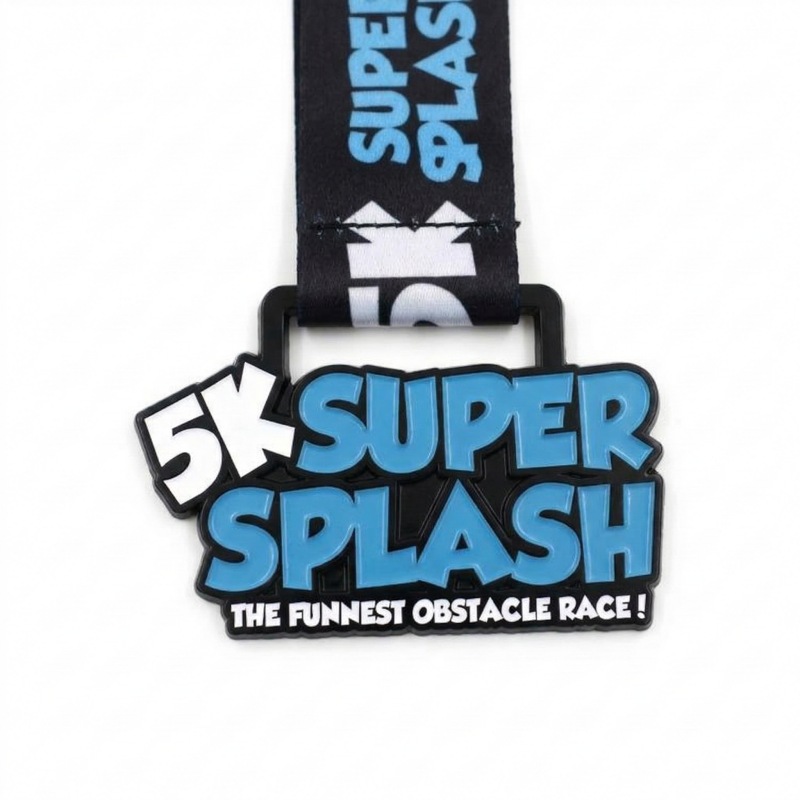
TL;DR: Custom marathon medals run through a 7-stage process taking 35-55 days and costing $1.20-$3.50 per unit depending on quantity, materials, and finish. Getting the first sample right means handing your factory vector artwork with minimum 0.15mm line widths. Hitting your race day deadline means locking in ocean freight at least 90 days before your event.
1. The 7 Stages of Custom Medal Production (and What Each One Actually Costs You)
Custom medal production runs through seven sequential stages: concept brief, design, quotation, sample, approval, mass production, and shipping. Full cycle is typically 35-55 days, with mass production itself taking 12-25 days depending on mold complexity and order size.
Most race directors calculate their timeline based only on factory production days. That’s the mistake. The hidden delays live in the “buyer time” — days spent negotiating revisions, waiting for a physical sample to clear customs, finalizing ribbon attachments, getting your board to sign off on the proof you forwarded them a week ago and they still haven’t opened.
Custom Medal Production Flow
| Stage | Duration | Primary Cost Driver | Who Controls It |
|---|---|---|---|
| 1. Concept Brief | 1-3 days | Internal design resources | Buyer |
| 2. Digital Proof | 24-48 hours | Factory artwork complexity | Factory |
| 3. Quotation | 1 day | Material market rates, exchange rates | Factory |
| 4. Physical Sample | 5-7 days | Mold fee ($50-$300) | Factory |
| 5. Approval Iteration | 3-10 days | Shipping speed of the physical sample | Buyer |
| 6. Mass Production | 12-25 days | Order quantity, hand-painted enamel steps | Factory |
| 7. Shipping | 5-35 days | Air freight vs. Sea freight choice | Logistics / Customs |
2. Choosing Your Medal’s Bones: Material, Thickness, and Why Iron Isn’t “Cheap Zinc”
A frequent error in commissioning custom medals is assuming material dictates prestige. Zinc alloy and iron dominate the race medal market, but they serve completely different manufacturing processes.
Zinc alloy has a density of around 7.1 g/cm³. Its primary manufacturing advantage is a relatively low melting point of 385°C, and that high fluidity lets molten zinc fill intricate mold cavities. If your medal requires 3D relief, cut-outs, deep enamel recesses, or multiple overlapping physical layers, the factory has to die-cast it in zinc alloy. There isn’t really another option at this price point.
Iron has a higher density of 7.85 g/cm³, so an iron medal feels slightly heavier in the hand than a zinc medal of identical dimensions. Iron is stamped, not cast. A massive hydraulic press strikes a 2D design into the cold metal block. Iron is exceptionally durable, but it strictly limits your design to flat surfaces with raised and recessed metal lines. It cannot do rounded 3D objects or intricate cut-outs.
Material Specs Comparison
| Material | Manufacturing Process | Best For | Density | Cost Index |
|---|---|---|---|---|
| Zinc Alloy | Die Casting | 3D designs, cut-outs, complex shapes | ~7.1 g/cm³ | Moderate |
| Iron | Die Striking (Stamping) | Flat 2D designs, high weight requirement | ~7.85 g/cm³ | Lowest |
| Brass/Copper | Die Striking | Hard enamel, premium presentation | ~8.9 g/cm³ | High |
Most marathon medals standardize at 3mm thickness. Stepping up to 4mm or 5mm dramatically improves how the medal feels in the runner’s hand, but you’ll pay for the extra raw material weight twice: once at the factory, then again at the freight forwarder.
3. Plating and Finish: Why Two “Gold” Medals Can Look Nothing Alike
Plating failures are the single biggest financial risk for race directors. Low-cost suppliers tend to use recycled zinc alloy with high impurities, paired with ultra-thin electroplating. A standard decorative plating runs only 0.03 to 0.05 microns thick.
At that microscopic thickness, the ocean freight journey alone can ruin the finish. Salt air and humidity work through the thin layer, the base metal oxidizes, and by the time you open the boxes 30 days later, your “shiny gold” medals look dull, tarnished, or visibly peeling at the edges. Premium suppliers apply multi-layer electroplating, sometimes up to 0.5 microns or higher, which gives an actual atmospheric barrier.
You need to spell out the finish type on your spec sheet.
- Shiny Finishes: Highly reflective, polished to a mirror finish. Shows fingerprints and micro-scratches.
- Matte Finishes: Sandblasted look. Best for legibility of fine text.
- Antique Finishes: A dark chemical wash applied and partially wiped away, leaving residue in the recesses. High contrast, makes 3D elements pop.
If your design has color, specify whether you want soft enamel (recessed paint sitting below the metal borders) or imitation hard enamel (overfilled and ground flush so paint sits level with the metal lines). These are not interchangeable.
4. Designing a Medal That Manufactures Well (Not Just Looks Good on Screen)
A design file that works for a t-shirt or a website header will routinely fail on a die-casting floor. Medals need distinct physical boundaries between colors, built from raised metal lines, and a lot of designers haven’t internalized this.
Your designer has to build the file to physical tolerances. The absolute minimum line width for raised metal on a soft enamel medal is 0.15mm to 0.2mm. If you request imitation hard enamel, that minimum jumps to 0.45mm to 0.5mm, because the grinding process at the end will destroy anything thinner.
The colored enamel is applied through tiny syringes by hand. So the minimum closed area (the recess) that can actually accept liquid enamel is 1mm to 2mm. If your race logo has fine overlapping text with enclosed gaps smaller than 1mm, the factory will fill those gaps with solid metal and your name becomes a metal blob. They will not call to ask. They’ll just ship it.
Designer Handoff Checklist:
- Files in pure vector format (.AI, .CDR, or vector .PDF)
- All fonts converted to outlines/curves
- Raised metal areas clearly marked in black
- Recessed enamel areas assigned Pantone Solid Coated (PMS) codes
- No metal line thinner than 0.2mm
- No enamel recess smaller than 1.5mm
- Text height at least 2mm, 3mm preferred
- Ribbon loop placement specified and structurally reinforced
I’ll still spec 0.2mm minimum even when the factory says 0.15 is fine. Old habit from a job where two runs in a row came back with broken metal lines, and I never trusted “fine” again.
5. MOQ, Mold Fees, and the Numbers Suppliers Won’t Volunteer
Most marathon medal manufacturers want a minimum order quantity (MOQ) of 100-500 pieces and charge a one-time mold fee of $50-$300. These are the gating numbers that decide whether an OEM factory will even open your email.
The mold fee covers CNC machining of the steel tool block that stamps or casts your medals. Standard 2D or 3D molds run between $50 and $110. Double-sided 3D designs push the tooling cost into the $150-$300 range. Manufacturers will typically waive the mold fee outright if your order crosses a volume threshold, usually somewhere between 1,000 and 3,000 pieces.
And here’s the part nobody tells first-time buyers: reputable factories retain your mold for two years. If you run the same race next year with the same design, you pay zero mold fees. Worth confirming this in writing before you sign.
2026 Estimated Pricing Tiers (per unit, standard 3-inch zinc alloy, soft enamel)
| Quantity | Estimated Mold Fee | Per Unit Cost | Total Capital Outlay |
|---|---|---|---|
| 100 | $55 | $3.50 | ~$405 |
| 500 | $55 | $2.80 | ~$1,455 |
| 1,000 | Waived | $2.20 | ~$2,200 |
| 3,000 | Waived | $1.70 | ~$5,100 |
| 5,000+ | Waived | $1.20 – $1.40 | $6,000+ |
Note: Manufacturing costs only. Freight and tariffs are separate, and they’re not small.
6. The Sample Stage: Your Last Chance to Catch a Disaster
Never authorize mass production from a digital 2D mockup. Demand a physical pre-production sample. The factory will charge the mold fee upfront, strike 3-5 physical units, and air-express one to you for sign-off.
This is the only intervention point that really matters. Once mass production starts, any error you find means paying for a full replacement run.
12-Point Sample Inspection Checklist:
- Weight. Does it feel substantial? Put it on a digital scale and confirm gram weight matches the spec sheet.
- Plating uniformity. Edges and recesses. Is the gold/silver evenly applied, or are there dark spots in the crevices?
- Enamel fill. Use a flashlight. Look for pinholes, trapped dust, uneven leveling.
- Color match. Hold the medal against a physical Pantone (PMS) coated fan book in natural sunlight. Not your office fluorescents.
- Text legibility. Can you read the date and location without squinting?
- Edge grinding. Run your thumb around the outer circumference. Should be smooth, no sharp casting flash.
- Loop strength. Try to bend the top attachment loop with your fingers. It should not yield.
- Ribbon attachment. Is the ribbon sewn securely? Does it lay flat when worn, or does the attachment angle cause the medal to flip?
- Sublimation alignment. If your ribbon has full-color sublimation printing, check the logo aligns on both sides.
- Thickness. Digital calipers. Verify it hits the 3mm or 4mm mark you paid for.
- Reverse side. Check the back. Sandblasted finish should be uniform.
- Packaging fit. Does the medal sit cleanly in the polybag or presentation box without ripping seams?
The weight check is the one most people skip and the one I’d never skip.
7. Shipping, Customs, and the Hidden 25% Cost (US Importers, Read This)
Factory unit prices rarely include the reality of international freight and customs duties. Those two factors can add 20% to 40% to your final landed cost.
Medals are heavy. A batch of 3,000 standard 3-inch zinc alloy medals weighs roughly 250 kilograms. Air freight takes 3-10 days, but Q1 2026 rates sit between $2.50 and $8.00 per kilogram depending on the lane. That 250kg order costs $625 to $2,000 just to fly across the Pacific. Sea freight (LCL — Less than Container Load) crushes air on price, $90 to $260 per cubic meter, and a 3,000-piece order fits easily on a single pallet. But sea needs a realistic 25-to-35 day window from the Chinese port to a US West Coast warehouse, and that’s before you’ve cleared customs or moved an inch inland.
For US buyers, customs classification adds another wrinkle. Base metal medals fall under HS Code 8306.29 (anecdotally — your specific design may classify slightly differently, ask a broker). Because they originate in China, they’re subject to Section 301 tariffs. Make sure your freight forwarder gives you a DDP (Delivered Duty Paid) quote, which folds in ocean transport, port handling, customs clearance, and final truck delivery to your door. If a forwarder won’t quote DDP, find another forwarder.
8. Timeline Reverse-Engineering: How Far Out Should You Start?
Race directors should start the custom medal process at least 90 days before race day to absorb design revisions, sample iteration, production, and international shipping. Skip that buffer and you’ll end up paying $2,000 for emergency air freight to save a race you committed to ten months ago.
The biggest disruption in the global supply chain is the Chinese New Year (CNY) shutdown. In 2026, the Year of the Horse, CNY lands on February 17. Operations do not stop for just one day. Logistics people treat CNY as a 6-to-8 week operational window running late January through mid-March. Factories shut down completely from roughly February 14 to February 23, and port congestion spikes hard in the weeks immediately prior as every global buyer scrambles to load containers. Your order is competing with everyone else’s order for the same container space, and your order is not a priority.
If your race is in March or April 2026, your purchase order needs to be issued by early December 2025. Earlier is better.
Reverse Timeline Example: October 15 Race Day
- October 1: Target delivery date (14-day buffer for lost boxes)
- August 25: Ocean freight departs China (35 days for transit and customs)
- August 1: Factory begins mass production (25 days)
- July 20: Buyer signs off on physical sample
- July 10: Factory finishes sample, ships via air express
- July 1: Factory begins mold tooling
- June 25: Initial contact, quotation, and design brief phase
This timeline assumes nothing goes wrong, which is not how anything works.
9. Choosing a Manufacturer Without Getting Burned
Alibaba and Google are flooded with intermediaries claiming to be direct factories. Using a trading company is fine if you want basic stock designs. For fully custom molds, putting a middleman between your designer and the die-casting floor invites the kind of miscommunication that produces 5,000 medals with the wrong PMS red.
A legitimate manufacturer will gladly send evidence of production control. Ask for videos of their zinc alloy die-casting machines, polishing stations, enamel fill lines. A real factory has these on file because they send them to every serious buyer.
Supplier Vetting Scorecard:
- Audit Reports. Request the BSCI (Business Social Compliance Initiative) or Sedex 4P audit report. A legitimate factory will give you a Member ID you can verify directly.
- Quality Management. Ask for the ISO 9001 certificate.
- Sample Policy. Do they refund the mold fee on bulk orders above a certain volume?
- Quotation Transparency. A professional quote breaks out unit price, mold fee, ribbon cost, individual polybag packaging, and DDP freight terms separately. If everything is bundled into one number, you’re being managed.
The quote transparency thing tells you almost everything about the supplier within the first email exchange.
Frequently Asked Questions
1. How much does a custom marathon medal cost?
Custom marathon medals typically cost between $1.20 and $3.50 per unit. Pricing scales with order quantity, base material (zinc alloy vs. iron), thickness, and enamel complexity.
2. What is the minimum order quantity for custom medals?
Most OEM manufacturers require an MOQ of 100 to 500 pieces to access competitive bulk pricing. Orders below 100 units are either rejected or priced prohibitively to cover factory setup costs.
3. How long does it take to make custom marathon medals?
The whole process is 35 to 55 days, but that’s the optimistic version. Factory production is 12 to 25 days. Sample approval is roughly 7 days if you respond quickly, more like 14 if your board needs to weigh in. International sea freight is 25 to 35 days port-to-port and you should add a week of inland transit and customs buffer on top of that. Most experienced race directors initiate the process 90 days before the event, and the ones who learned the hard way go to 120.
4. Do I have to pay a mold fee for custom medals?
Yes. $50 to $300 for the steel tool. Waived for bulk orders, often around 1,000-3,000 units, and for repeat orders using the identical design.